
Every autumn the same thing happens. The bin goes quiet, nothing much seems to be breaking down, and people start wondering whether theirs has broken.
Almost always it has not. Composting slows down when it gets cold, and that is normal. But there is a real difference between a bin that has slowed and a bin that has stopped, and a few things worth sorting out now rather than in January.
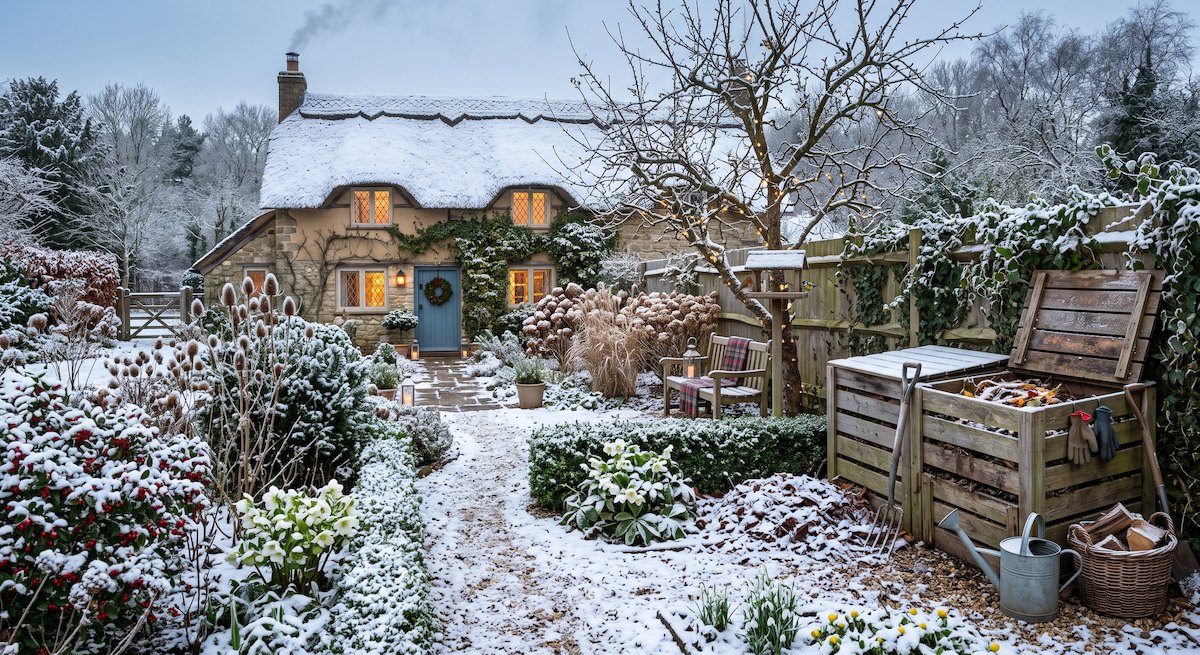
Why compost slows down in winter
There is a rule of thumb in biology that for every 10°C rise in temperature, the speed of the reaction roughly doubles. Run it backwards and you can see the problem. Compost at 60°C works around 32 times faster than compost at 10°C.
That is the whole of winter composting in one sentence. Nothing is broken. The bacteria are just cold and slow.
In an ordinary cold bin, that is the end of it. From November to March a dalek bin does very little. Material goes in, nothing much comes out, and it waits for spring.
A hot composter is different, because the heat is generated inside by the bacteria themselves. Your job in winter is to stop that heat escaping and keep feeding the thing that makes it. I run a HOTBIN and a Green Johanna at home and both keep going, with a bit more attention than they need in July.
Size matters more than you think
Heat escapes from the surface. The smaller the bin, the more surface it has relative to the material inside, so the faster it loses what it makes.
This is why an open heap needs to be at least a cubic metre to hold enough heat to keep working, and why a half-empty bin struggles in winter no matter how well you feed it.
Insulated bins get round this, which is the entire point of them. But if you are running an open heap or a wooden bay, bulk is your insulation. Build it up before the cold arrives rather than during it.
The browns problem
This one catches people out and it has nothing to do with temperature.
Through summer your browns come from the garden. Prunings, dry leaves, hedge trimmings. Then autumn ends, the garden stops producing, and you are still generating exactly as much kitchen waste as before.
So you end up feeding the bin nothing but wet food waste. It compacts, the air runs out, and it goes cold and slimy. People blame the weather when the real problem is the mix.
Sort this now:
- Bag up autumn leaves and keep them dry near the bin. This is the best free source of winter browns, and I have written about collecting them in what to do with autumn leaves.
- Keep a box of shredded paper and torn cardboard by the back door. Tape off first.
- Get a bag of woodchip in. If you run a HOTBIN you need it anyway.
There is more on the balance in my guide to greens and browns.
Keeping the heat in, by bin type
HOTBIN
The insulation is built into the walls, so there is nothing to add. What matters is feeding it enough to stay hot. The 200L wants around 5kg of waste a week and the Mini around 2.5kg. Drop below that in December and it cools, and a cold bin is much harder to restart than a warm one is to maintain.
Keep the woodchip going in with every feed.
Green Johanna
Fit the insulating jacket. Put it on when average outdoor temperatures are consistently below 5°C, which in most of the UK means November.
Mine is a faff to fit and I say so every year. From November onwards it is the difference between a working bin and a frozen one. More detail in my full Green Johanna guide.
Tumblers
Thin walls, no insulation, raised off the ground. Tumblers feel the cold more than anything else and will slow right down.
Turn it less than you would in summer. Turning vents heat out of the middle, which you can afford in July and cannot in January. Treat winter as a holding period rather than a production one, and expect to finish the batch in spring.
Wooden bins and open heaps
These lose heat fastest of all. Bulk them up, and insulate from the outside. Bags of leaves stacked around the sides, straw bales, or cardboard lining the inside walls all work and cost nothing. An old carpet or a tarpaulin over the top keeps cold rain out, though on its own it will not keep a heap working.
Wormeries
Composting worms are cold-blooded and want somewhere between about 10 and 25°C. They tolerate cold, but if it freezes inside the wormery it can kill them.
Move it into a shed, garage or greenhouse if you can. If not, put it tight against a house wall and wrap it in cardboard, bubble wrap or old carpet, leaving the air gaps clear.
The bigger mistake is feeding them the same amount as in summer. Worms eat far less when cold, and uneaten food sits and rots, turning the bin acidic and airless. That is what actually kills wormeries in winter, not the cold itself. Feed less, and keep the shredded paper and cardboard going in.
Bokashi
Worth knowing about if you are fed up with going outside in the dark. Bokashi is an indoor, sealed, fermenting system that takes cooked food, meat and dairy, and it does not care what the weather is doing. What comes out is a pre-compost that needs burying or adding to a bin to finish, so it works best alongside an outdoor system rather than instead of one.
Where the bin sits
Get it out of the wind. Moving air carries heat away from a bin, and a spot against a wall or fence, or tucked behind a shed, makes a real difference for nothing.
On sun versus shade, it depends what you have. For an uninsulated bin or an open heap, a sunnier spot genuinely helps because you are relying on whatever external warmth you can get. For an insulated bin it barely matters, and shade is better for the other nine months because full sun dries the contents out.
Which brings up the honest bit. You cannot move a full bin. This is a decision you make once, when you set it up, so weigh the whole year rather than just January.
Feeding through winter
Little and often beats one big load. A large cold dump pulls the temperature down and it takes days to recover.
Chop things smaller than you would in summer. More surface area matters more when everything is running slowly.
Cover every food addition with browns. Same rule as always, but there is less spare heat in the system now to deal with a soggy patch.
And keep feeding it. A bin fed regularly through winter stays warm. A bin abandoned in November is a cold heap by Christmas and will not really wake up until April.
One practical thing that makes this much easier: keep a lidded caddy or bucket inside. Nobody wants to walk down a wet garden in the dark every evening, and this is the main reason people quietly give up on composting over winter.
Rats
This is the winter composting problem nobody wants to talk about, so let us deal with it properly.
Winter is the high-risk season. A compost bin offers a rat everything it wants at exactly the time of year it wants it. Warmth, shelter, a dry undisturbed place to nest and a regular supply of food arriving at the top. A pile that has cooled down and dried out is more attractive still.
What actually helps:
- Use a sealed bin. Enclosed systems are far harder to get into than open heaps or pallet bins. This is the main reason people move to a hot composter after a bad experience.
- Close off underneath. Rats burrow up from below. Paving slabs or heavy-gauge wire mesh under the bin blocks that route. Not chicken wire, which they can chew through.
- Keep it damp. A dry bin is a comfortable nest. Damp is both better compost and less appealing.
- Disturb it. Rats want to be left alone. A bin you walk past and knock every day is a far less attractive place to settle than one at the bottom of the garden behind a shed.
- Keep it away from cover. Rats travel along edges, fence lines and the gaps behind buildings. Which does pull against the wind advice above, so use your judgement about which problem you actually have.
On food waste, be careful with the standard advice. Most guidance says never add meat, fish or cooked food, and for an open heap or a basic dalek bin that is exactly right. For a sealed hot composter like a HOTBIN or a Green Johanna it does not apply in the same way, because the food is enclosed and the bin runs hot. That is precisely what those bins are designed for. Know which kind you have before you follow generic advice.
One genuinely useful thing about hot composting: the bacterium in rat urine that causes Weil's disease does not survive above about 37°C, so a bin running at 40 to 60°C deals with it. But once compost has cooled and is sitting maturing, it could survive again, so keep rats out of that stage too. Wear gloves when handling finished compost and wash your hands afterwards. Sensible practice whether you have seen a rat or not.
And to be straight with you, no bin is completely rat-proof. Anyone who tells you otherwise is selling something. You are reducing the odds, not eliminating them.
What normal looks like in January
Your bin will be cooler than it was in August, and compost will take longer. A HOTBIN that turned things round in 30 to 90 days in summer will sit at the slower end of that.
You may see steam when you open the lid on a cold morning. Good sign.
The surface can look completely dead while the middle is still working. In a HOTBIN the top layer is the hot bit and the base sits close to outside temperature, so do not judge the whole bin by whatever is nearest the door.
If it has stopped, or frozen
Work through these in order.
Is it too wet? Squeeze a handful. It should feel like a wrung-out sponge. If water runs out, add plenty of dry browns and mix through.
Has it compacted? Open it up with a fork or aerator and add coarse browns like woodchip and twigs to hold the structure open.
Is there anything to eat? A bin full of dry leaves and cardboard has no fuel in it. Add fresh food waste.
Is it insulated? Jacket on. Out of the wind if you can manage it.
If it has genuinely frozen solid, leave it alone. Do not try to break it up or dig into it. Keep adding material to the top and let it thaw in its own time. Frozen material is not spoiled, and freezing actually helps break down cell walls, so it often takes off quickly once things warm up.
A dormant bin is lost time, not a lost bin.
The one job worth doing before it gets cold
Empty out whatever is already finished.
Take the finished compost from the bottom now, while it is easy to get at and while you can still use it. Spread it on beds and borders as a winter mulch. It protects the soil, feeds the worms and saves you a job in spring.
It also gives you room. A bin with space in it is far easier to manage through winter than one full to the lid in November.
Thinking about upgrading
If you are here because your ordinary bin has stopped and you are fed up with it, a hot composter keeps working when a cold one does not, and it takes the cooked food and meat that a dalek bin cannot.
The HOTBIN 200L is insulated as standard and needs nothing extra for winter. The Green Johanna with the Winter Jacket is cheaper bought together than adding the jacket later, and if you are buying in autumn you want both.
Honest caveat. A bin started from scratch in midwinter is slow, because there is no established microbial life in it and no warmth to help. It will work. It just will not be quick. If you can wait for spring, wait.
Further reading
- What to do with autumn leaves in your garden
- Greens and browns: a proper guide for hot composters
- Green Johanna 330L Hot Composter: a complete guide
- How to start a hot composter and get the early days right
- All hot composters

I'm Adam, the founder of Compost Guy. I'm passionate about empowering people to embrace composting! Whether you're a seasoned composter or just starting your journey, I'm here to help.


